Gulf Coast humidity and mature tree canopies in historic Houston neighborhoods like The Heights, Montrose, and River Oaks create constant upward roof-rat pressure. Tree limbs overhanging cedar shingle or composite…
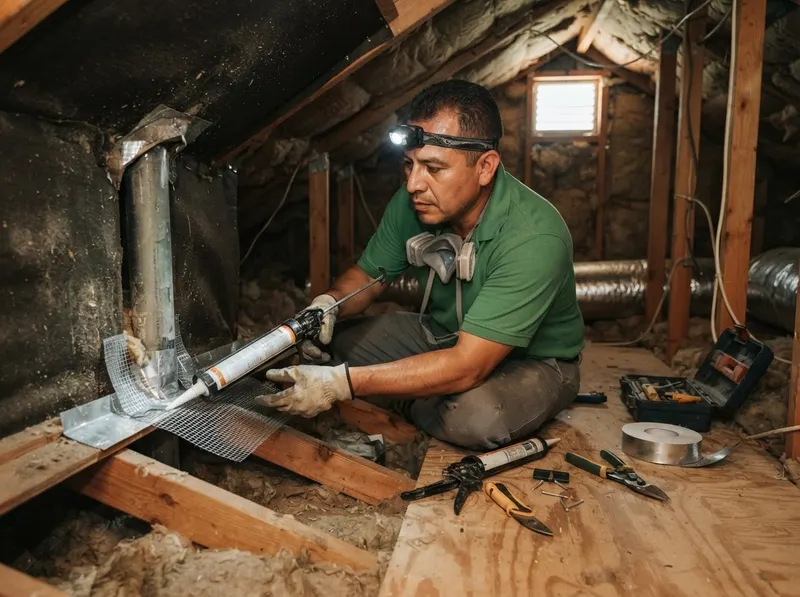
Gulf Coast humidity and mature tree canopies in historic Houston neighborhoods like The Heights, Montrose, and River Oaks create constant upward roof-rat pressure. Tree limbs overhanging cedar shingle or composite roofs allow roof rats (Rattus rattus) direct access to fascia junctions, soffit vents, and ridge vents. In newer construction throughout Kingwood, Memorial, and West University Place, builder-gap openings behind gutter lines often leave 1- to 2-inch continuous voids into the attic crawlspace. Standard surface trapping removes individual rodents but fails to stop re-entry; physical exclusion seals these structural breaches with 1/4-inch 19-gauge galvanized hardware cloth, high-density polymer barriers, and exterior-grade metal flashing that rodents cannot chew through.
Attic remediation requires removing insulation compressed by urine and rodent feces, which harbor leptospirosis and airborne allergens. In flood-prone sections of Meyerland, Oak Forest, and Clear Lake, elevated humidity worsens rodent odor and speeds bacterial growth on saturated building materials near attic decking. A specialized 15-horsepower vacuum system outside the dwelling extracts fouled cellulose or fiberglass through sealed 6-inch hoses, preventing secondary indoor air contamination. Technicians treat bare joists with an EPA-registered hospital-grade disinfectant to eliminate microbial organisms and pheromone scent markers that attract future colonies, followed by the replacement of blown-in fiberglass or cellulose to reach current Texas thermal energy standards (R-38 value).
Homeowners selecting between mechanical exclusion and chemical bait programs face a clear trade-off: exterior poison bait boxes suppress local population counts near foundational perimeters, but poisoned rodents can die inside inaccessible wall cavities, causing significant odor and insect infestations. Mechanical exclusion requires an upfront structural investment but permanently fortifies the building envelope against outside entry. Structural exclusion with attic restoration stops the continuous re-infestation cycle, keeps toxic materials away from family pets, and protects attic wiring from fire hazards caused by gnawed electrical lines.
Every job gets a firm, written price after a free on-site visit.
Tell us about your rodent exclusion and attic cleanout job in Houston and we'll send a clear, written quote, usually the same day.
 Homestead Pest Control